Worldlessness
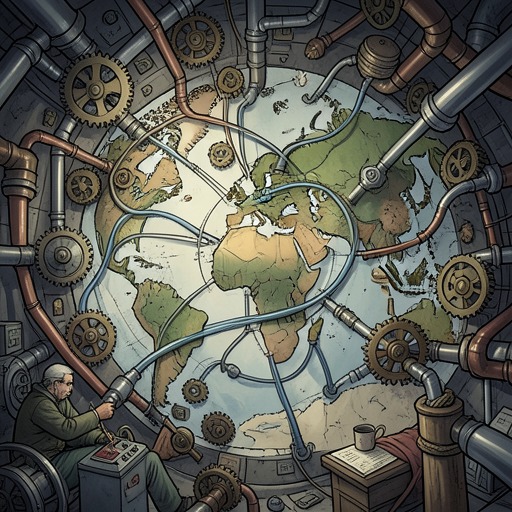
The Parallax ViewWorldlessness is the paradoxical condition in which global capitalism encompasses the world without forming a world: it operates across different cultural settings but does not provide most people with a meaningful cognitive map or a stable horizon for collective engagement. In Slavoj Žižek’s account of Alain Badiou’s argument, this condition alters the problem of emancipatory politics. Capitalism not only disrupts established social frames; through its own constant self-revolutionizing, it incorporates disruption into the way it reproduces itself.
What worldlessness means
A world, in this account, is more than a territory or a collection of societies. It is a framework that makes reality intelligible by naming a situation, identifying its stakes, and giving people a sense of how they might act within it. The example of Nazi anti-Semitism illustrates this descriptive point: by inventing a conspiracy, designating an enemy, and specifying goals and means, it offered its adherents a comprehensive, if murderous and false, cognitive map. The contrast is not an endorsement of that map but a way to clarify what capitalism lacks. Although capitalism is global and reaches across many cultural worlds, it is not itself a civilization with a distinctive symbolic order that gives the majority a coherent account of their place and possibilities.
Its universality is therefore presented as a neutral economic-symbolic matrix rather than as a particular cultural world. The worldwide triumph of Europe, in this reading, becomes a kind of self-obliteration: capitalism’s reach severs its assumed bond to a specifically European cultural identity. Criticism that searches only for capitalism’s concealed Eurocentric bias consequently misses the sharper claim. Capitalism’s power lies in operating across cultural differences without needing to become the culture of any one world.
Excess built into capitalist reproduction
Worldlessness is bound to capitalism’s unusual relation to excess. In earlier social formations, an element excluded from the established order could become a point from which political action challenged that order. Capitalism, by contrast, reproduces itself by repeatedly overcoming its own limits. What might otherwise appear as a deviation or surplus is not simply kept outside the system: excess becomes a motor of its ordinary operation, and permanent self-revolutionizing becomes part of social normality.
The account of capitalist value helps explain why this movement cannot be reduced to a simple opposition between a substantial productive economy and supposedly unreal speculation. Karl Marx’s analysis is presented as holding production and circulation together in a parallax: value cannot be assigned to either sphere alone. The production process can function as a detour in the speculative movement of money generating more money, while speculative logic also drives the expansion and transformation of production. Even the substantial economy is thus propelled by a constitutive illusion rather than standing as capitalism’s solid, independent opposite.
The commodity offers a concrete image of the gap between an object and the social form it occupies. A wooden table remains an ordinary useful thing, yet as a commodity it acquires a transcendent social character and enters relations that cannot be explained by its material properties alone. The form is not a disposable surface concealing a self-sufficient essence: the form itself is essential to what the commodity becomes. This insistence on the force of economic form parallels the larger account of worldlessness, in which capitalism’s social power cannot be located in a stable cultural substance beneath its changing appearances.
Administration and permanent self-revolution
The historical account of Lacan’s four discourses places worldlessness within two intertwined aspects of modernity. One is expert administration: bureaucratic and technological forms of rule that regulate populations, increasingly treating them as objects of biopolitical control. The other is capitalist-individualist dynamism, in which a subjectivity of continual questioning and change is integrated into the reproduction of the system. These are not successive stages that can simply be translated into one another. They are distinct, mutually implicated faces of a social order whose instability and administration coexist.
The contrast with the Master’s discourse sharpens the historical point. In the account offered here, the modern Master is associated with absolute monarchy, while the University and hysterical discourses express different outcomes of the Master’s weakening: expert rule on one side, and a capitalist subjectivity organized around permanent doubt and self-revolution on the other. The Analyst’s discourse, in its emancipatory formulation, suggests a way to address the subject at the point where its existing ideological organization turns symptomatically, and to loosen the Master-Signifier that structures it.
Yet the contemporary social link complicates that hope. The injunction to enjoy can itself occupy the position of authority: the object-cause of desire, objet petit a, is placed where the Master-Signifier would be, short-circuiting the two. In that configuration, a command to act and enjoy can coexist with expert knowledge that promises to help subjects manage its demands. The proposed interruption is a separation between the Master-Signifier and objet petit a, rather than their fusion into a single command. Worldlessness therefore concerns not only the absence of a shared map but also the forms of power and enjoyment through which subjects are organized within that absence.
The political problem of making a world
Badiou’s account of evental politics traditionally gives emancipatory action a point of intervention: the part of a situation that belongs to it yet has no recognized place within it. From that excluded position, an event can disrupt the order’s settled representation. Worldlessness unsettles this model. If capitalism itself repeatedly destabilizes representational frames and makes excess a condition of reproduction, political intervention cannot rely on finding an excess that the system simply leaves outside.
The resulting difficulty reverses the expected task. In a world whose organization is already unstable and whose reproduction does not require a fixed cultural frame, emancipatory politics may need to construct a new world: to create names and shared coordinates through which excluded people can sustain new truth procedures and meaningful collective action. The prescription is difficult to reconcile with the account of events as disruptions of worlds. Žižek therefore identifies an inconsistency in Badiou’s response: the theory describes political events as breaking a world’s established order, yet the diagnosis of the present calls for an ordering work that would make a world possible.
This tension is not resolved by choosing either disruption or construction as the single correct strategy. It marks the distinctive political stakes of worldlessness: capitalism can dissolve fixed social forms and absorb ongoing transformation, while offering no common horizon adequate to collective life. Any emancipatory project must confront both sides of that condition—the system’s capacity to turn excess into its own driving force and the need to create forms of orientation that are not merely another instrument of administration.